Radio!
[audiotrack number=2 title=”Radio” width=100px mp3=”https://tedgresham.com/audio/rdo.mp3″]
For a limited time, listen to this story in audio.
A Personal Story by H.J. Ted Gresham
KTRE Radio & TV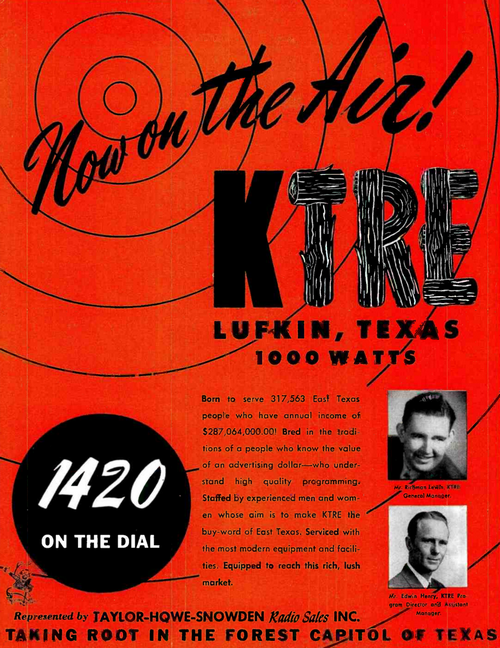
Downtown Lufkin there’s a two-story building on First Street near Frank, on the East side of the street, that has an old collection of rooms, offices and other empty spaces, where at one time the main offices of a popular TV and radio station, KTRE (Channel 9 TV and 1420 AM radio) was located. Accessing the office required climbing a ridiculously long set of steps. No elevators back then. The business is long gone from there. The TV station offices are at their broadcast location and the radio station is now defunct.
A few years ago I went up to that old office complex where some people were actually living at the time. I was amazed at how much it still looked like it had. There was the foyer and front office area, the manager’s office, the large room once used for live broadcasts. Down and around the hall were the small studio rooms that were once live studios. The old doors were still there, massive heavy doors still with the signs on them: “Advertising” and “Studio.” What memories that visit brought back!
Early years
It took some effort to climb up those old stairs. Once my dad dropped his heavy toolbox at the top of the stairs and it banged and clanged down the steps and went right through the plate-glass door, crashing the glass to bits. That was an interesting event. Once up the stairs in those days you’d enter a very nice open area where people were busy with the station’s activities. To the immediate left was the manager’s office, a big swanky affair with a huge desk. Until 1964 that office belonged to Richmand Lewin, a man everyone loved and respected. I do not remember him but I remember the sadness in the family when he died.
Dad worked for radio station part, 1420 AM. He used to take me with him when he visited the downtown offices and main studios of the station. That was before I started school. I have great memories of that time. All the people who worked in the downtown office knew me. The morning show on KTRE was run by a guy named Hampton Keithly, a friendly man who was always fun to talk to. His show was called “Hamp and Eggs.” He’d aways welcome me there.
I met some men who would go on to networks and become well known later, men like Bill Carter and Murfy Martin, who went on to network TV. Another man I remember was Hank Huggins. He was a big, jolly, happy man. He was often in the downtown offices. He also had a weekly TV broadcast called The Double H Ranch (Double H from his name, Hank Huggins). Many local musicians played on that show; some were great and some, as I recall, should have stayed home. We watched the show faithfully, but then there was only the one station to watch anyway.
Every Christmas there’d be a big party. We’d go. All the TV and radio staff gathered to celebrate the season. I remember the parties. They were held in the ballroom of the then-fancy Angelina Hotel. The ballroom was called “the mirror room” because the walls, support beams and every other space was covered with mirrors. It was a spectacular party in a spectacular place.
The TV station always had a special broadcast where all the kids of the station’s staff would be gathered up and sing Christmas carols on TV. I was one of those who went there. I don’t really remember it all that well but it was a big deal at the time.
The Kilocycle Kitchen
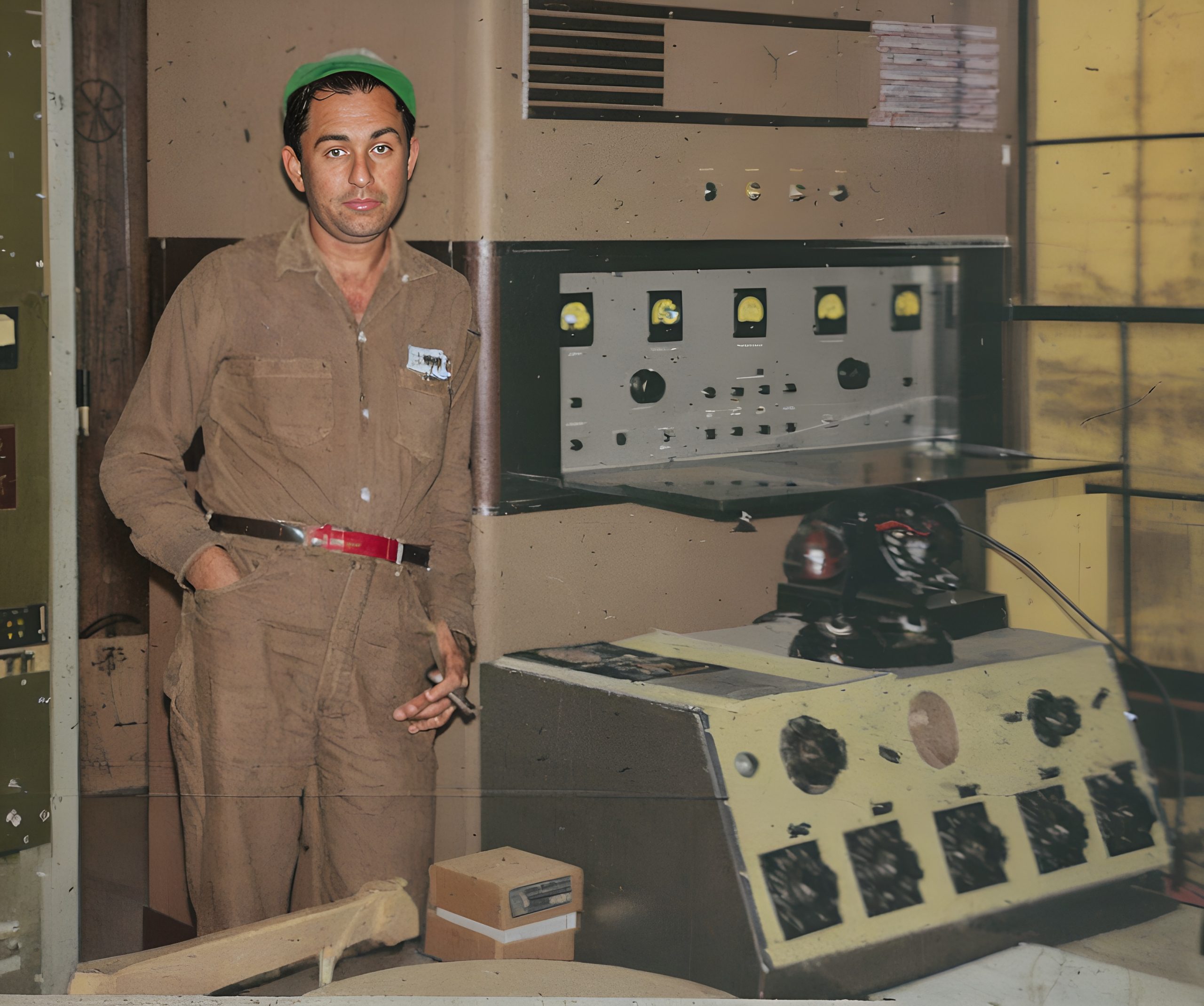 As I said, Dad worked for the radio side of the company. He went to the downtown offices to check on the equipment and check in with his boss but he spent most of his time working at the transmitter station located less than a quarter mile from our house. My parents had in fact bought the house because it was close by. Dad jokingly called the Transmitter building the Kilocycle Kitchen. It was in reference to the kilocycles the station broadcast.
The shift dad worked was usually from 6 PM to “sign off,” six days per week. Back then neither TV nor radio station played all night. They would both sign off at midnight. Dad was the primary engineer. He held a “First Class” radio/telephone operator permit issued by the FCC. The FCC required the station to have a “First Class” operator on duty at night with KTRE because it’s signal was “directional.” This means that the station’s signal was controlled at night by way of using a second tower.
Stations are made “directional” to protect the signal of other stations on the same or a close frequency. AM radio travels a long way at night and station signals ran together in places without one of them being directional. It was very important that the station signal be maintained and Dad was the guy to do it.
Since he had to be at work, the station gave him a night shift on the radio. Dad played music, mostly, or sat by while a Houston Astros game was broadcast. He never used a microphone, saying he sounded too hillbilly. I’d spend lots of nights there with him. When I was a little kid I’d take two office chairs and push them together in front of the old window air conditioner and go to sleep. I was always a happy camper back then.
I spent a lot of time at the station with dad. When I got older, I’d learn about how the station worked. Dad would explain the electronics to me. I had a dream of working in radio myself. I even went to Houston and tested for a “Third Class” operator permit. The FCC required radio announcers (DJs) to have one back then.
Bomb Shelter
In the sixties the great scare was the possibility of a nuclear war with Russia. KTRE Radio was the “designated station” for our area, meaning it would stay on and broadcast information in the event of a nuclear war when all other stations would cease operating. KTRE was very serious about their status. In the mid-sixties they built a bomb shelter beside the transmitter building. I remember it being built.
We played on the scaffolding and climbed over it and entered the station through the open space where the door to the station would be. There was nobody there doing the day, since the station broadcast came from the downtown studios, so it was fun and a little spooky sneaking in there. While in there we gathered up a collection of magazines, publications meant only for men, if you read my meaning. (Some time I’ll tell you about those magazines and Dad finding them!)
Dad looked at the whole bomb-shelter thing with amusement. The shelter itself had twelve-inch-thick walls and an eight-inch-thick roof of solid concrete. There was no blast door, just an ordinary wooden door at the opening. The entrance led down a hallway with solid concrete walls. Through it the shelter opened up to a really creepy room.
Once finished, the station owners had dad move the transmitters and required electronics into the shelter. I remember dad working long hours to get that job done. Later on they had him install a studio, too, so he built one there. From then on the nighttime broadcasts came from that studio. Being a concrete building, it had terrible acoustics.
The builders had been nice enough to leave a hole in the wall where an a/c unit was placed. I suppose the hope was that a bomb blast would come from the other direction and not so close as to blast through that a/c window. We’ve had plenty of jokes about that. Eventually that mistake was corrected and the hole was filled in.
Whoever designed the building did a piss-poor job. Like I said, there was no blast door so a massive blast, as an atom bomb would have been, would have traveled through the hallway and destroyed whatever was in there. Of course there was reserve power, a massive army-surplus generator sitting all alone outside under a shelter. I often wondered if they considered that the towers and generator would be blown away by the “big bomb,” making whatever was left in the bomb shelter rather useless.
Transmitters
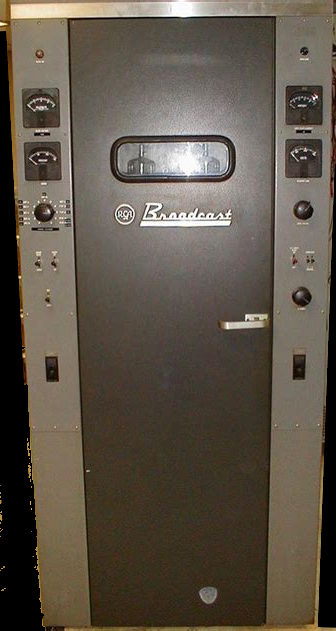 The radio station had two transmitters which stood to the left as one entered the building before they were moved into the bomb shelter. Those are devices that translate audio to radio frequency. In those days transmitters were huge things with massive tubes doing the work. KTRE had an RCA transmitter, about five feet square and maybe eight or so feet high. It had a window in the front where someone could see the primary tubes, huge tubes with two attachments on each end. Dad said those were 303s. (I actually have one of them as a keepsake now!) Next to the RCA was much larger Raytheon transmitter. It was twice as wide as the RCA. That transmitter was only a stand-by unit. (Many years later I remember seeing a truck pulling a trailer from there hauling that old transmitter away.)
The old RCA would “sing” with the sound of the station, coming somehow from the electronics of the transmitter. I remember the smells of the station too, stale cigarette smoke and the indescribable scent coming from dust on the hot transmitter tubes. Those are very good memories.
The Blast
For some reason, the transmitter building was built on wooden stilts a good six feet above the ground. A large open porch ran along the front of the building. Once, me and my neighbor were playing on the steps of the huge porch. I don’t remember how old I was then, maybe ten or twelve. We were on the steps when suddenly the radio station wall lit up in a huge explosion. That scared the hell out of both of us. I was so horrified my mouth was stuck open and I couldn’t make a sound, only a kind of silent scream.
Dad came outside to check on us and I remember being unable to talk. My friend and I were perfectly fine but we sure were frightened. The power line to the station had been damaged by a recent storm and the wind caused the lines to touch, sending a blast of electricity down the line to blow the meter away. All I knew was that something blew up and I was scared shitless. Dad calmed me down.
Dad had to work long hours for a few days to repair the damage to the electrical system on the outside and inside of the building. The blast had not only destroyed the meter outside but had also blown out all the electrical circuits on the inside wall. The transmitters used a massive amount of electricity. Those circuits were very big.
Outside the Transmitter Building
The station sat on a very large space of land. There was the drive circling up to the station and a circle driveway. The main building where the studio and transmitters were faced the drive in the center of the curve. Nearby was an old building holding a bunch of old equipment. Once dad had to clean out that old building so it could be torn down. I snagged some of that surplus equipment and made my own pretend radio station at home.
Two large radio towers were out from the station building, surrounded by an open grassy area of several acres. The studio was connected to the towers by a low fence-like structure about three feet high, with copper tubes on the top. Those tubes transmitted the radio signal to the towers. The tubes were about an inch in diameter. I remember you could put your ear to them and hear the broadcast. It was weird but fun.
We would play at the station a lot when I was a kid. Once we flew a kite and I got it so far up in the sky using several hundred feet off twine that it just stuck there without falling. It was barely visible. I tied it off to that weird fence thing and went home. When I came back it was still there. Cool.
Once, when I was sixteen, I drove my car into the field to go hunting doves. I did not know how soft the dirt was. My car sank to the axles. I struggled and struggled and tried to get it out but nothing worked. I got so mad I just left it there and walked home. I told dad what happened. He got a good laugh out of me and my predicament. Then he went down the road to a neighbor who had a big tractor. That guy went down to the car, hooked on a chain, and drug the car like a block of sheet metal out to the road. Problem solved.
The Last Days
KTRE TV has a nice history of the TV station on its website which covers the early years of the station. It is a history about the TV station but up through the sixties the radio station was a major part of the company. In fact, the radio came first. The men who ran the radio station from the 1940s developed the TV station after the radio station had been on for years. The TV station started broadcasting in the mid-fifties. See that article here.
Some time in the late sixties or early seventies the company sold the radio station. Call letters were changed to KLUF. The old transmitter building was enlarged and the new KLUF business office was installed there. As I grew older I didn’t visit the station so much.
Moving On
Dad quit the station when I was in Junior High. He looked for another job at other radio stations. He went to a station in New Boston, near Texarkana, to apply. I went with him. The manager was someone dad had worked with in the past. He would have put dad to work that day if dad had taken a live shift but he turned it down because he didn’t think his voice was radio quality. He was wrong but I could not convince him otherwise.
Eventually dad went to work as an electrician in Diboll at a plant that made particle board. His salary was far better than the radio station. Radio stations never pay living wages. Mom was very happy with him working there. He hated it. After a couple of years he wound up back in Radio. He took a job with KRBA, the all-time rival of KTRE, with a big pay cut. My mom was not happy about that.
KRBA
 KRBA grew to be a much more popular station in the sixties than KTRE because they were a rock station. In the seventies, by the time Dad worked there, their popularity was dropping because FM stations in the area were gaining ground but they still had a lot of listeners. While dad worked at KRBA he oversaw the installation of an FM, call letters KDEY. The call letters reflected the owner, Derryl E. Yates. That station was automated and played what was called “Easy Listening” in those days. They played Engelbert Humperdinck, Barry Manilow, Anne Murray, Neil Diamond and similar artists. It was a format, ironically, that KTRE Radio had before it sold.
Dad worked at KRBA several years, during the time I quit High School and went into the Air Force. At one time, I do not know exactly when, I talked to Mr. Yates about working a shift there. I hoped to put my third-class license to use. I hung out at the studio with the DJs some but never did get a shift myself. About the time I started College in the early 80s dad retired. Nevertheless, his retirement was not the last time I was around radio.
Me and Radio
My first shot at being a radio DJ came in the late seventies, when I went to work at KSPL, a station that simulcast on AM and FM. I worked a lonely early Sunday morning shift at the station. They had two studios, one located at their offices in the La Quita Motel in Lufkin and their transmitter building in Diboll. I worked in Diboll. KSPL played “Outlaw Country” music. One morning my mom was taken to the hospital and I called my boss to let me get off early to go there. He came in all pissed and fired me on the spot.
A few months later that same program director of KSPL, Atmar Lester, contacted me and asked me to take a shift at his new station, KSPL AM Gospel. He had gotten religion. He apologized to me for the way he had treated me earlier and offered me a job. I took it. I worked Sunday Mornings at God’s new station, KSPL Gospel. That job led to me taking the job as program director at KBSN, Crane, Texas. At last I was working full time in radio. But that is another story.
Copyright 2026, All Rights Reserved